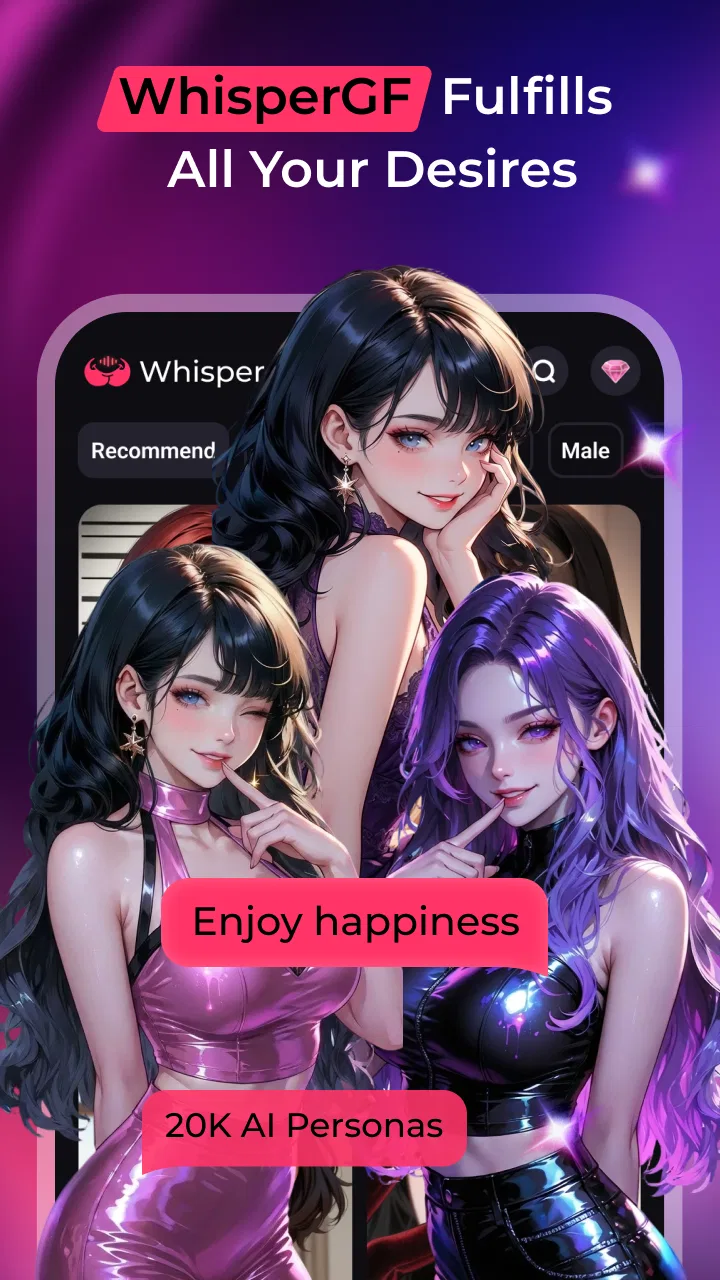
WhisperGF:Always Near You
- 4.7
- Rating
- 100.00K
- Installs
- Free
- Price

 Analysis by App-foxy
I approached WhisperGF: Always Near You as a quiet entertainment app rather than a conventional social network or a productivity tool. Its central appeal is simple: it gives you an AI chat space for private-feeling conversations, reflection, and moments when you want company without the pressure of replying to a real person immediately. After spending time with it, I found that its value depends less on dramatic features and more on whether you enjoy a calm, conversational routine.
That distinction matters. This is not the app I would choose for factual research, serious emotional care, or a busy community full of people to meet. I see it as a more personal alternative to scrolling through entertainment feeds: something you open when you want to talk, think out loud, or create a small pause in the day. The mature audience label is important here, and anyone considering it should be comfortable with an AI conversation designed for adults.
Developed by BOLTEC PROPERTIES LIMITED, the app is free to install and sits in the entertainment category. It has attracted over one hundred thousand installs and holds a 4.7 average from around six thousand ratings, which suggests that its focused concept is connecting with a meaningful group of users. I would still treat those numbers as a starting point rather than a guarantee, because an AI companion can feel very different from one person to another.
You May Also Like

 Blood Strike: 2.5 Anniversary
Blood Strike’s Loadouts Turn Every Drop Into a Tactical Gamble
A close look at Blood Strike’s custom loadouts: how fast access to signature weapons reshapes its battle royale rhythm, rewards preparation, and narrows the gap between fights.

 Pandora - Music & Podcasts
Pandora’s Music Is Easy to Start, but Harder to Recover
Pandora’s strength is its low-effort path from a seed to a station. Its weak spot is how much confidence it asks you to place in connection, setup, and quiet recovery.

 8 Ball Pool
 Is Built on Rivalries, Rematches, and Routine
A close look at the rivalries, rematches, shared routines, and unanswered safety questions that turn a quick pool match into a persistent mobile community.

 Samsung Music
’s Quiet Strength Is Playing What You Already Own
Its reach comes less from spectacle than from dependable access to a personal library. That simplicity is both the app’s strongest retention engine and its ceiling.

 AccuWeather: Weather Radar
AccuWeather Review: A Quick, Clear Forecast for Everyday Decisions
For everyday plans, the best forecast is the one you can understand quickly. AccuWeather makes rain timing, radar, and local conditions easy to act on, with a few trade-offs.

 Hill Climb Racing
Why Hill Climb Racing Still Turns Crashes Into One More Run
A tiny car, a bumpy hill and one more upgrade: Hill Climb Racing keeps resurfacing because its simple chaos makes every near-miss feel personal.
More From Our News Desk
View All News


How the current experience feels in everyday use
I find it useful to judge this kind of chat by how it fits around ordinary routines, not by whether it can imitate a close relationship. In a shared home, that means thinking about who might pick up the device and what sort of conversation they could encounter. From there, the key question is how each person can keep their own boundaries clear.
A calmer alternative to the usual entertainment feed
The first thing that separates this app from many entertainment downloads is the pace. A video feed asks me to keep consuming, while a standard messaging service assumes another person is waiting for an answer. WhisperGF occupies the space between those experiences. I can open it with a thought, a mood, or no clear topic at all, and let the conversation develop at my speed.
That makes it especially suitable for small, repeatable moments. Imagine finishing work late, putting your phone down for a few minutes, and wanting to express what went well and what went badly without starting a complicated conversation with a friend. An AI chat companion can provide a low-pressure place to organize those thoughts. I would not confuse that with human support, but I can see why the format feels comfortable when the alternative is silence or endless scrolling.
The strongest use case is not a long, intense session. It is a brief check-in that helps you shift gears. I found the idea more useful when I gave the chat a clear purpose, such as describing the day, exploring a fictional scenario, or asking for a different perspective on a minor problem. Opening it with no intention can still work, but the conversation may feel less satisfying if I expect it to entertain me automatically.
What the app is really offering
The name and positioning point toward an always-available companion, but I think the practical benefit is the combination of privacy in the moment and conversational flexibility. There is no need to coordinate schedules, explain why I am messaging, or wait for someone to become available. That convenience is the product’s main strength, and it is also why expectations need to stay realistic.
An AI can respond quickly and maintain a conversational flow, yet it does not bring a real person’s lived experience, responsibility, or genuine concern. For casual talk, imaginative exchanges, and personal journaling prompts, that limitation may be acceptable. For a crisis, medical decision, relationship conflict with serious consequences, or anything that needs professional judgment, I would choose a qualified human source instead.
I also recommend deciding beforehand what kind of role you want the app to play. If you treat it as a private conversational notebook with replies, it is easier to judge fairly. If you expect a perfect partner who remembers every nuance, understands you flawlessly, and always says the right thing, disappointment is much more likely. The experience improves when I use it as a tool for conversation rather than a replacement for relationships.
Three practical ways to get more from it
My first useful approach was to begin with a specific conversational frame. Instead of writing a vague greeting, I would say what I wanted from the exchange: a gentle check-in, a playful conversation, a place to sort through an idea, or an imaginative scene. This small change gives the session direction and makes the app feel less like a blank text box.
A second approach is to use it as a transition ritual. I could chat briefly after waking up to set an intention for the day, or use a short evening conversation to separate work concerns from personal time. The benefit is not that the AI solves anything automatically. The benefit is that writing a thought down and receiving a response can make an otherwise vague mood easier to examine.
The third is to keep sensitive information limited. Even when an app feels personal, I would avoid sharing passwords, financial details, identifying documents, or information about another person that I would not want repeated. That is sensible with any online chat service, but it becomes especially important when the conversation feels intimate. The warmer the interaction seems, the easier it is to overshare without thinking.
Who is likely to enjoy it
I think the app is a good fit for adults who like conversational entertainment but do not want the demands of a public social platform. It may appeal to someone who enjoys roleplay, reflective prompts, low-pressure companionship, or simply having a place to type thoughts at an unusual hour. The lack of a human audience can be a benefit for users who feel self-conscious posting publicly.
It also suits people who want a repeatable personal routine rather than a large collection of separate features. If your favorite apps are focused experiences, this narrow purpose may feel refreshing. You can return to the same type of interaction without learning a complicated interface or keeping up with a community.
I would skip it if you are looking for live human conversation, a moderated support group, a dating service, or a reliable source of expert answers. It is also a poor match if you dislike the idea of talking with an AI on principle. The app’s whole value comes from accepting that format, so no amount of polish will overcome that basic preference.
How it compares with familiar alternatives
Compared with ordinary messaging apps, this experience is more available but less genuinely reciprocal. A friend can challenge me, remember shared experiences, and notice when my words do not match my mood. WhisperGF can respond without scheduling, but its understanding remains generated rather than personal.
Compared with social media, it is less distracting and less public. There are no crowds to impress and no stream that constantly competes for attention. That can make a short session feel more intentional. On the other hand, social platforms provide real communities, current events, and spontaneous human humor that an AI companion cannot reproduce in the same way.
Compared with a dedicated journaling app, the advantage is the reply. A journal lets me write without interruption and review my own patterns over time, while this format turns a private thought into a dialogue. The trade-off is that conversation can steer my attention away from my original idea. For serious self-reflection, I would sometimes write the thought down first and chat afterward, rather than letting the response define the entire exercise.
What the current version tells me about its direction
The current version is 2.2.8, and the app’s release date is listed as April 10, 2026. Those details place the product in a relatively current stage of development, but they should not be read as proof that every future update will improve the experience in a particular way. What I can reasonably say is that the app is being presented as an active, focused product rather than an abandoned experiment.
For existing users, a version number is most useful as a practical reference. If the app behaves differently after an update, knowing the installed version helps separate a change in the product from a temporary issue on one device. I would also avoid assuming that a later version automatically changes the basic relationship with the service. The core appeal remains the calm AI conversation, so users should judge updates by how well that central interaction works for them.
The free entry point lowers the barrier to trying it, which is important for a product based on personal fit. I could test whether the tone and rhythm suit me before committing money. At the same time, the presence of in-app purchases ranging from $3.49 to $54.99 per item means I would pay attention before confirming anything. A free download does not mean every part of the experience is free, and the difference between trying the app and making it a regular paid habit deserves consideration.
Where friction can appear
The biggest limitation is inherent to AI companionship: a response can sound appropriate without being truly perceptive. A polished sentence is not the same as understanding. If I am already emotionally tired, a reply that misses the point can feel more irritating than silence because it creates the impression of closeness without delivering the depth of a person who knows me.
Conversation fatigue is another realistic issue. An app built around chat can become repetitive if I approach every session in the same way. I found that changing the purpose of a conversation helps, but users who want constant novelty may eventually prefer games, video, music, or a human community. This is a focused experience, and focus can feel limited when the mood changes.
The mature rating also narrows its audience. Adults should consider whether the tone and subject matter are appropriate for their own boundaries, particularly if a younger family member might use the same device. I would not treat the app as suitable for children simply because it is easy to open or has a friendly conversational format.
There is also a personal-boundary trade-off. The more naturally I chat, the more likely I am to reveal details I would normally keep private. I recommend creating a simple rule before using it: discuss feelings and fictional situations freely if you wish, but keep identifying, financial, medical, and security information out of the conversation. That habit protects the user without undermining the app’s main purpose.
Questions I would consider before installing
If you are wondering whether you need an account or a particular routine to enjoy it, my practical answer is to start with a short, clearly defined session rather than trying to build a deep attachment immediately. See whether the conversation feels natural, whether the responses help you relax or think, and whether you enjoy returning to the format. That test is more revealing than judging the concept from its name.
If cost is your concern, the app is free to install, but paid items are available from $3.49 up to $54.99 each. I would use the free experience first and only spend money after deciding that the app has a regular place in my routine. A purchase should solve a need I already understand, not be an impulse caused by a particularly engaging conversation.
If you are asking whether it can replace a therapist, close friend, or emergency service, I would say no. It can help me put words around a feeling or rehearse how I might express something, but it cannot take responsibility for my wellbeing. In serious situations, I would contact a trusted person or an appropriate professional instead.
If you want to know whether it is better than a normal chat app, that depends on what you value. It is better for immediate, low-pressure availability and private-feeling entertainment. A normal chat app is better for authentic connection, shared history, and mutual care. I would choose between them based on the kind of conversation I actually need, not on which application has the more appealing interface.
What I would watch as the product develops
The most important future question is whether the conversations become more consistently useful without losing their calm character. I would watch for improvements that make sessions feel less repetitive, give users clearer control over the style of interaction, and help people understand the boundaries of AI companionship. Those changes would matter more to me than a long list of decorative additions.
I would also pay attention to how the paid side of the app develops. Since the download is free but individual purchases can reach a substantial amount, clarity around what each purchase changes will be important for trust. Users should be able to tell whether they are paying for a meaningful improvement in their routine or simply extending a momentary impulse.
Finally, I would look for signs that the app continues to respect the difference between entertainment and support. The strongest version of this product would encourage enjoyable, reflective conversation while making it easy for users to keep healthy boundaries. That balance is what could turn a novelty into a dependable part of someone’s day.
My overall view is positive but measured. WhisperGF: Always Near You works best as an adult-oriented AI conversation space for quiet moments, not as a universal answer to loneliness or a substitute for real relationships. I like the low-pressure format, the focused purpose, and the possibility of turning a few minutes of typing into a useful pause. I would recommend trying it to adults who are curious about companion-style chat, especially if they approach it with clear boundaries and modest expectations.
For me, the deciding question is simple: do you want a calm conversational prompt that is available when you are, or do you want genuine human connection and broader entertainment? If it is the first, this app is worth exploring at no initial cost. If it is the second, a messaging service, community platform, journal, or professional resource will probably serve you better. That honest distinction is what makes the app easier to appreciate on its own terms.
FAQs for WhisperGF:Always Near You
01What is WhisperGF: Always Near You?
WhisperGF: Always Near You is an AI companion app designed to provide conversational interaction through a virtual girlfriend-style character. Users can chat, share thoughts, and enjoy personalized responses intended to feel warm and engaging. The experience is primarily entertainment-focused, so it should not be considered a replacement for real relationships, professional counseling, or dependable emotional support in serious situations.
02Is WhisperGF: Always Near You free to download and use?
The app may be available to download at no initial cost, but some features can require in-app purchases, a subscription, or premium credits. Depending on the version and platform, access to extended conversations, personalization options, exclusive characters, or additional content may be limited for free users. Check the store listing and payment screen carefully before confirming any purchase or recurring subscription.
03Does WhisperGF: Always Near You require an internet connection?
Yes, users should generally expect to need an active internet connection because conversations and AI-generated replies are commonly processed through online services. Performance may depend on connection quality, server availability, and the app’s current service status. If you are offline, responses may fail to load or certain features may be unavailable, even if the application itself is already installed.
04Is my personal information and chat history private?
Before using WhisperGF: Always Near You, review its privacy policy and the permissions requested during setup. Conversations may be transmitted to company servers to generate replies, and account or device information may be collected depending on the app’s configuration. Avoid sharing passwords, financial details, precise personal identifiers, or highly sensitive information unless you fully understand how the data is stored and used.
05Is WhisperGF: Always Near You suitable for children?
Parents should check the app’s official age rating and content guidelines before allowing a child to use it. AI companion applications may include romantic themes, mature conversations, user-generated prompts, or responses that are not consistently appropriate for minors. The app can also encourage extended interaction, so parental supervision, device controls, and careful review of purchases are recommended for younger users.
Pros
- AI girlfriend chats naturally across a range of everyday topics.
- Personalized conversations can make interactions feel more engaging over time.
- Available whenever you want
- without needing to coordinate with another person.
- Simple interface makes starting a conversation quick and easy.
- Can provide a private space for casual conversation and emotional expression.
Cons
- AI responses may sometimes feel repetitive
- generic
- or emotionally inaccurate.
- Some features or extended usage may require in-app purchases or subscriptions.
- Privacy policies should be reviewed before sharing personal or sensitive details.
- The app may encourage excessive screen time or emotional dependence.
- Requires a stable internet connection for most conversations and features.

WhisperGF:Always Near You
Gallery